
Quality & Production
How to Approve a Pre-Production Sample Before Bulk Production
How to review and approve a pre-production sample for custom promotional products from China — what to check, how to give revision feedback, documenting the approval, and preventing bulk-order quality
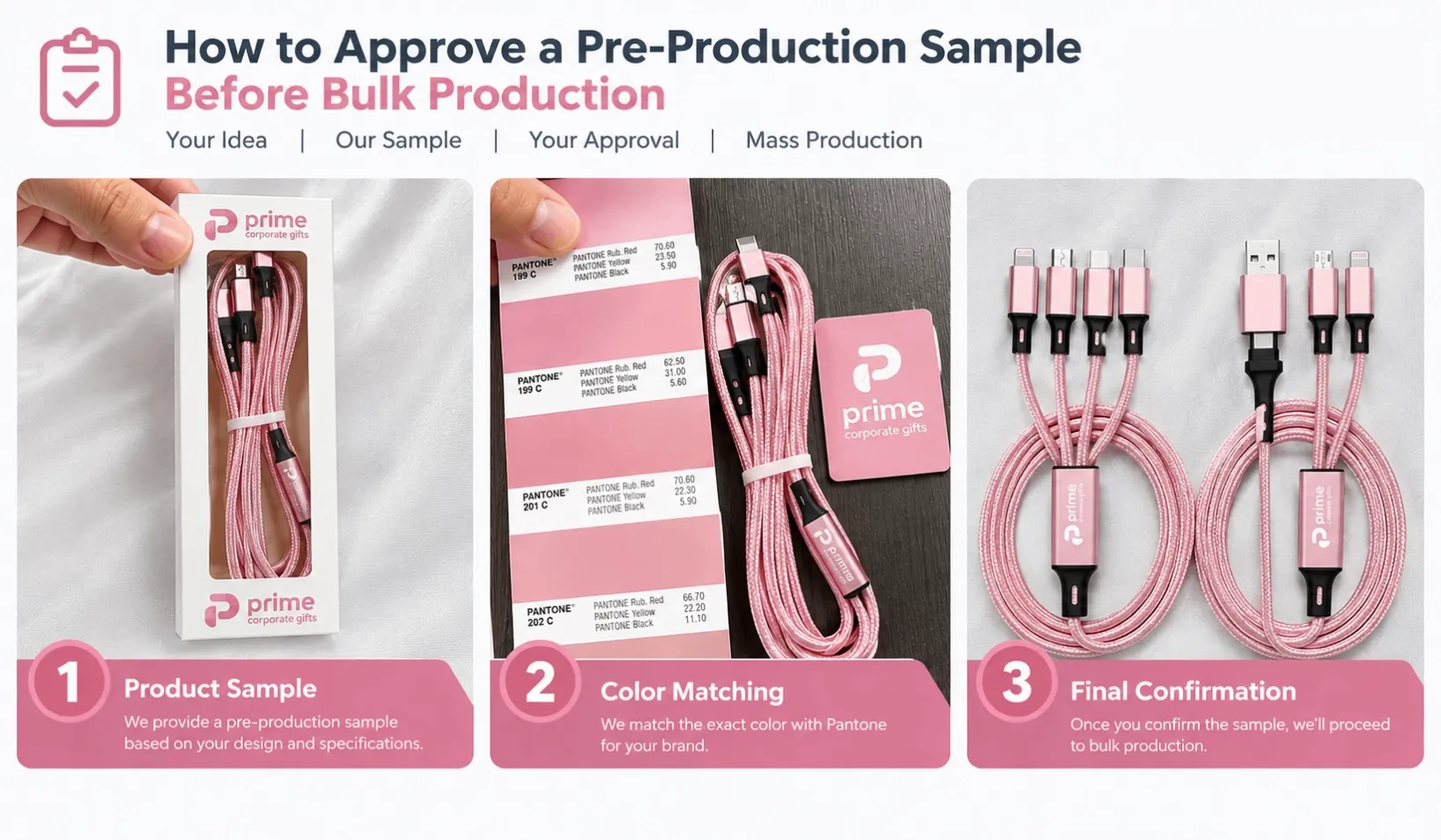
The pre-production sample is the single most important checkpoint in a custom promotional product order from China. It is the moment when your specification stops being a document and becomes a physical object — and it is the last moment when changing something costs days instead of destroying a production run.
This guide explains what a pre-production sample is for, what to check when it arrives, how to give approval or revision feedback that a factory can act on, and how to document the approval so the bulk order can be measured against it.
What a Pre-Production Sample Is (and What It Is Not)
A pre-production sample — sometimes called a PP sample, approval sample or golden sample — is a physical unit produced using the same materials, methods and specification as the upcoming bulk order, made before production starts.
What it is:
- The production standard. Once approved, this sample — not the mockup, not the rendering, not the artwork file — defines what the bulk order must match.
- Your last low-cost correction point. A change made at sample stage is cheap. The same change after production starts is expensive or impossible.
- The reference for quality inspection. Verifying the bulk order against an approved physical sample is objective; verifying against a description is not.
What it is not:
- Not a digital mockup. A mockup shows placement and proportion only. It cannot show how ink sits on a surface, how engraving reads on a particular metal, or how a color behaves on the actual material. Approving from a mockup is the most common — and most costly — mistake in the whole process.
- Not the same as a "sales sample." Some suppliers send an attractive example from existing stock that does not exactly match your specification. Always confirm the sample was produced to your specification with your artwork, and say so explicitly in the request.
- Not a formality. Treating the sample as a rubber stamp and approving it in five minutes is how defective runs get locked in: whatever you approve becomes the standard for thousands of pieces.
What to Check When the Sample Arrives
Check the sample in a structured way rather than a general "looks good" impression. A practical checklist:
Area | What to Check | Common Failure |
|---|---|---|
Logo: size and placement | Measure the logo against the approved artwork; check position on the product, including centering | Logo 2–3mm off-center or larger/smaller than approved |
Logo: color | Compare against the Pantone reference under natural light, not on screen | Color matched to screen, looks different in hand |
Logo: legibility | Hold the product at arm's length — the real viewing distance | Fine detail or small text illegible in actual use |
Logo: method quality | Engraving depth and consistency; print edge sharpness; embroidery density | Uneven engraving, fuzzy print edges, sparse stitching |
Product: function | Test the product's actual function — tumbler temperature, zipper movement, charger output | Customization affected the product's function |
Product: material and build | Material feel, weight, seams, joints, hardware; compare with your reference product if you have one | Material thinner or lighter than expected |
Product: color | Body color against your reference (coating, dye or molded color) | Color noticeably away from the reference and no agreed tolerance |
Packaging (if included) | Box structure, print quality, fit of products in the insert, closure | Products loose in the insert, box 5mm too small |
Quantity fit | If the sample includes accessories, check they fit and are included | Missing accessory or wrong size accessory |
Two habits that make sample review sharper. First, review under natural light and at arm's length, not under a desk lamp while holding the product close. Second, review against your written specification line by line — checking what you asked for, not just what the sample is — because a sample can be beautiful and still be wrong (wrong size, wrong material grade, missing feature).
Approval, Revision, or Rejection: How to Respond
After review, exactly one of three responses is appropriate. Being precise here saves rounds of back-and-forth.
Approving the Sample
Approve in writing with the details locked:
- State that the sample is approved as the production standard.
- Identify the sample (photos with any markings, or the sample's serial/reference if provided).
- Note any agreed tolerances — for example, logo color matched to the approved reference, product color within the sample's range.
- Confirm the next step: bulk production start, with its timeline.
Keep this written approval — it is the document the final inspection references. If the supplier's platform or your team has a formal sample approval form, use it; if not, a clear email thread with photos works.
Requesting a Revision
Revisions happen; what matters is making them actionable. Write each required change in specific terms:
- Be specific and measurable. "Logo should be 15% larger and centered, matching the approved artwork" is actionable. "The logo looks a bit small" invites the factory to guess, and guess wrong.
- Reference the standard. Point to the approved artwork file, the Pantone reference, or the specification line that was missed.
- Prioritize. If there are several issues, state which are must-fix before production and which are acceptable variations — otherwise the factory may adjust something you were fine with.
- Ask about impact. A revision can affect the timeline or cost; ask the supplier what the change does to both before confirming.
Rejecting and Restarting
If the sample misses the specification fundamentally — wrong material, wrong product structure, unusable quality — reject it clearly and restate the specification. A rejection is not a failure of the process; it is the process working. The expensive version is accepting a fundamentally wrong sample to avoid a delay, then discovering the problem in the bulk order.
Documenting the Approval So It Actually Protects You
An approval only protects you if it can be compared later. The minimum documentation:
- The approved sample itself — keep it. If the factory keeps it, keep detailed photos including close-ups of the logo, any markings, and the packaging.
- Written approval listing what was approved, with photos or the sample's identifying marks.
- Specification of tolerances — what may vary slightly (color tone within the agreed range) and what may not (logo size, placement, material).
- Artwork reference — the exact vector file used to produce the sample, with its version noted.
This package becomes the quality standard for the bulk order. When goods arrive, the inspection compares against these documents and the retained sample — which is what makes a quality dispute resolvable instead of a matter of opinion.
How Long Sampling Takes and Why It Sometimes Runs Long
Typical sampling timelines for standard products with standard customization:
- 1–2 weeks: stock product with print or engraving, straightforward artwork.
- 2–3 weeks: custom colors, custom packaging, or a product that needs a small modification.
- 4+ weeks: custom tooling, complex multi-part products, or projects involving several products sampled in parallel.
Delays usually come from three sources: artwork that needed adjustment before sampling could start (send your file early and in the right format — see our guide to logo printing methods), a specification detail that was unclear and had to be clarified mid-sample, and revision rounds. Sending complete artwork and specifications with the original request is the most effective way to keep sampling on schedule.
One planning note for multi-product orders: request all samples in parallel and review them together, so one product's revision does not delay the others. Our guide to sourcing multiple gift products covers how to sequence parallel samples and combined approvals.
Frequently Asked Questions
Do I have to pay for a pre-production sample?
Usually yes — samples are typically charged, and the fee is often credited back against the bulk order if the project proceeds. The cost covers the actual production of the sample, and for printed or engraved products, the setup involved. Confirm the sample cost and whether it is credited before ordering, and treat it as a project cost rather than an optional extra.
Can I approve a sample based on photos if I can't receive the physical sample?
Photos are better than nothing, but they cannot substitute for the physical sample in color, material feel, engraving depth, print edge quality and surface finish — all the things photos normalize or hide. If a physical sample cannot be sent (budget, timeline or logistics), state which attributes you are approving from photos and which you expect to match the factory's standard production quality, and be explicit about the risk you are accepting.
What if the bulk order does not match the approved sample?
The written approval and retained sample are what make this a resolvable issue. Compare the arrival against the approved sample and documentation during inspection; where goods deviate from the approved standard, you have a documented basis to require rework or a remedy before final payment. Without a written approval and retained sample, the discussion becomes a matter of differing opinions. This is the core reason the sample-approval step exists.
How many revision rounds should I expect?
For most standard products with clear artwork and specification, one sample is approved without revision. Projects that involve custom colors, custom packaging or modified products may see one revision round. Multiple revision rounds usually signal a specification that was not quite producible as described — worth revisiting the specification itself rather than iterating the sample indefinitely.
Should the sample be produced by the same factory as the bulk order?
Yes — the sample's purpose is to predict the bulk order, and only the producing factory can do that. A "similar" sample from another source tells you nothing about the factory that will make your order. When working through a sourcing partner or trading company, confirm in writing that the sample comes from the production factory that will make the bulk order, using the same materials and methods.
Next Step
Sample approval comes down to four practices: require a physical sample produced to your exact specification, review it against your written requirements under natural light at real viewing distance, respond with specific and prioritized feedback, and document the approval with tolerances so the bulk order has a standard to match.
If you have a project entering the sampling stage, send us your requirement — we will arrange samples produced to specification, walk you through what to check for each product type, and record the approval so the bulk order and the final inspection reference the same standard. You can also review our product categories before you decide the direction.